Guide 08 Radio listening independent information
How to improve FM radio reception at home
Most reception problems have simple fixes. Start with position and antenna, then work out whether the signal is weak, reflected or drowned in noise.
Start with the simple fixes
Before buying anything, change three things. Move the radio, extend and rotate its antenna and make sure the station is actually strong enough where you live. A station that sounds fine in the car may be weak inside a building. Check that the antenna wire or telescopic rod is fully connected and extended.
Move the radio, not the world
A few feet can change everything. Try a window, preferably one that faces the transmitter, and a higher spot. Radio waves are absorbed by walls, bodies and appliances, so keep the radio away from large metal objects and away from computers, routers and chargers that make their own noise.
Wire and dipole antennas for FM
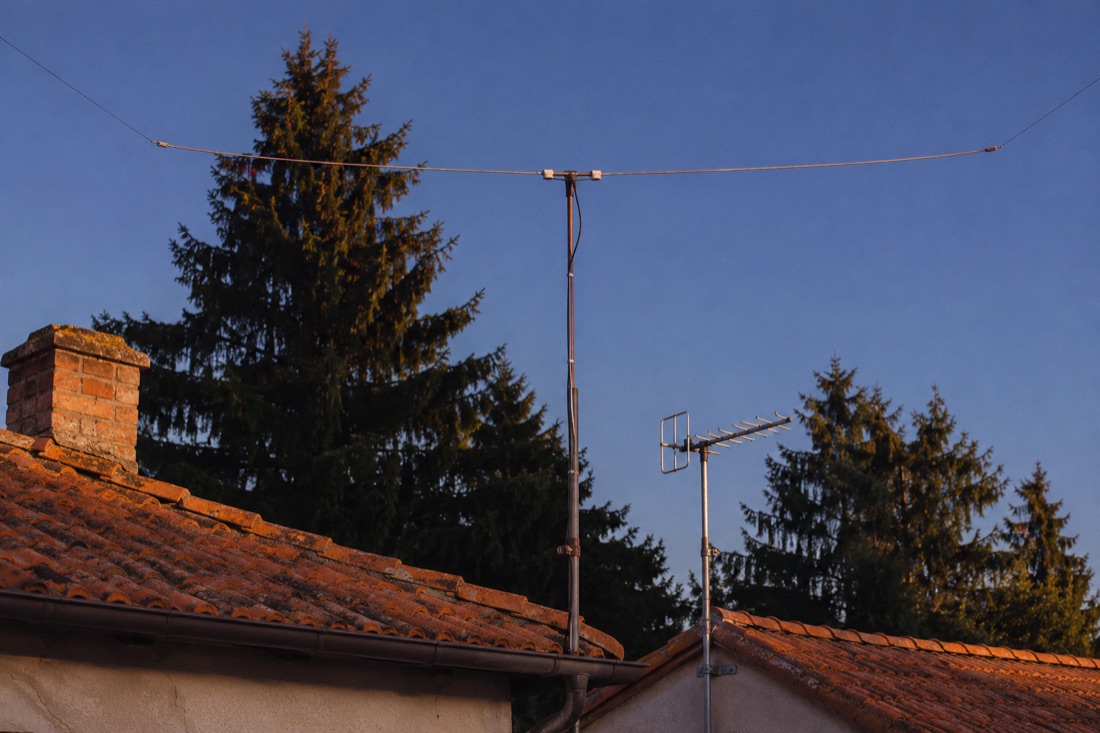
FM wavelengths are about three meters, which makes a half-wave dipole about one and a half meters long, with each side about 75 centimeters. That is why many receivers come with a T-shaped wire. Spread the two arms out in a straight T, as high as you can, rather than coiling them. A telescopic antenna should be extended to roughly the same length. A properly set up simple dipole often beats an amplified indoor antenna.
Multipath and why stations warble
A signal can reach you directly and also bounce off hills and buildings. The two arrive slightly apart, and the sound can distort, flutter or change in loudness when you move. This is called multipath. Moving the antenna a short distance or turning it often fixes it. If a stereo signal is hissy, the mono switch on a receiver can lower the noise, since stereo needs a stronger signal to sound clean.
Reception inside metal and concrete buildings
A metal roof, steel framing or metallized insulation and windows can block most of the signal. Place the radio close to a window, or run an antenna lead to a window or outdoors. In an office or warehouse, a wire hanging outside may be the only practical answer.
AM: loop antennas and noise
AM works differently, as explained in AM vs FM. Many AM radios contain a ferrite bar antenna that is strongly directional, so rotating the whole radio changes the signal. An external AM loop antenna works with a radio's own antenna by coupling the signal into it, and its directionality can be used to turn away from noise. Most AM interference at home is electrical: LED bulbs, dimmers, power supplies and chargers. Unplug them one at a time to find the culprit.
When an amplified antenna helps
An amplified antenna can lift a weak distant signal, but it can also overload a receiver when strong local stations are nearby and make things worse. Try it as the last step after trying the placement and wire fixes. If you enjoy chasing faint stations, the DXing guide is next.